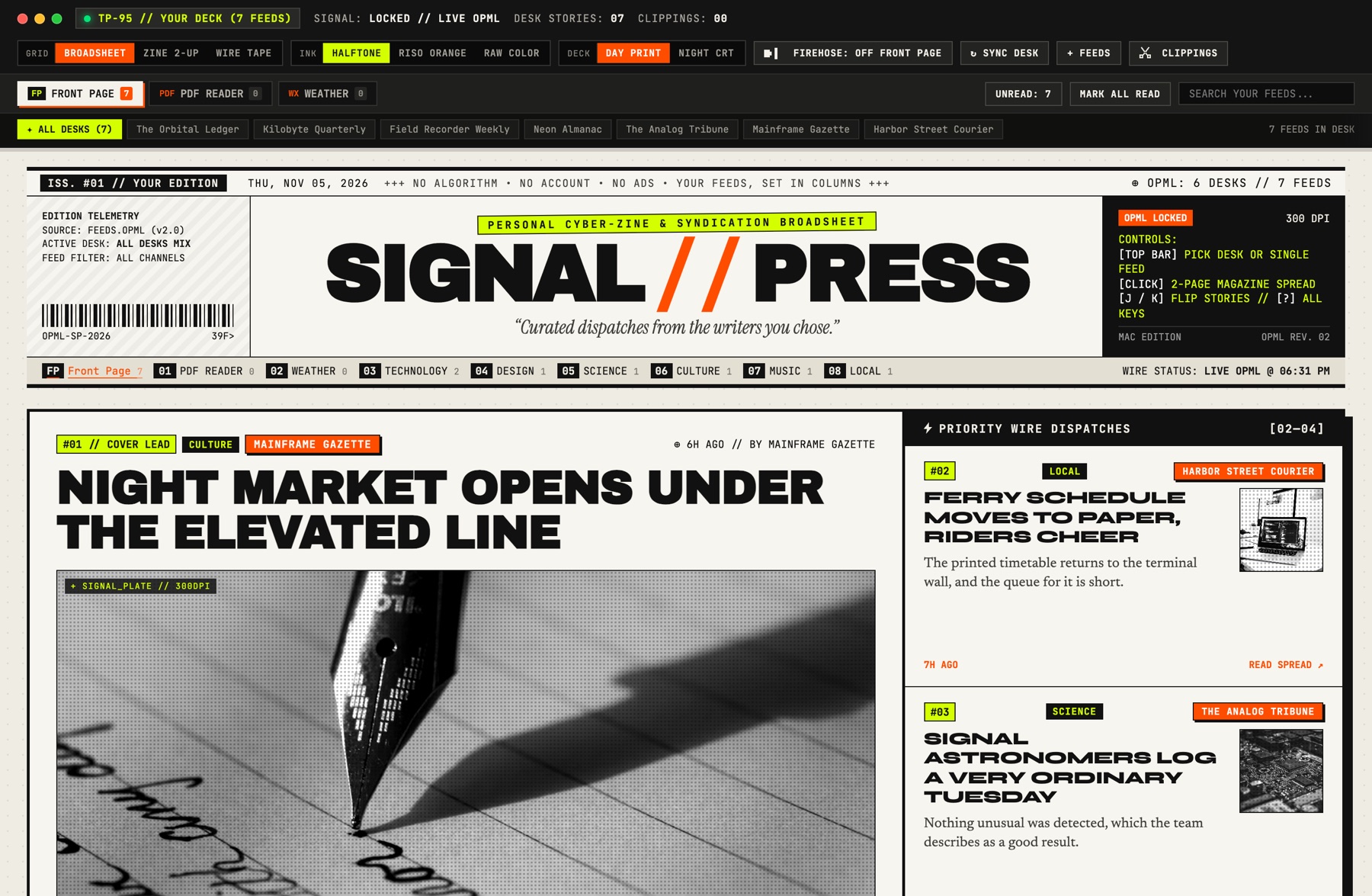
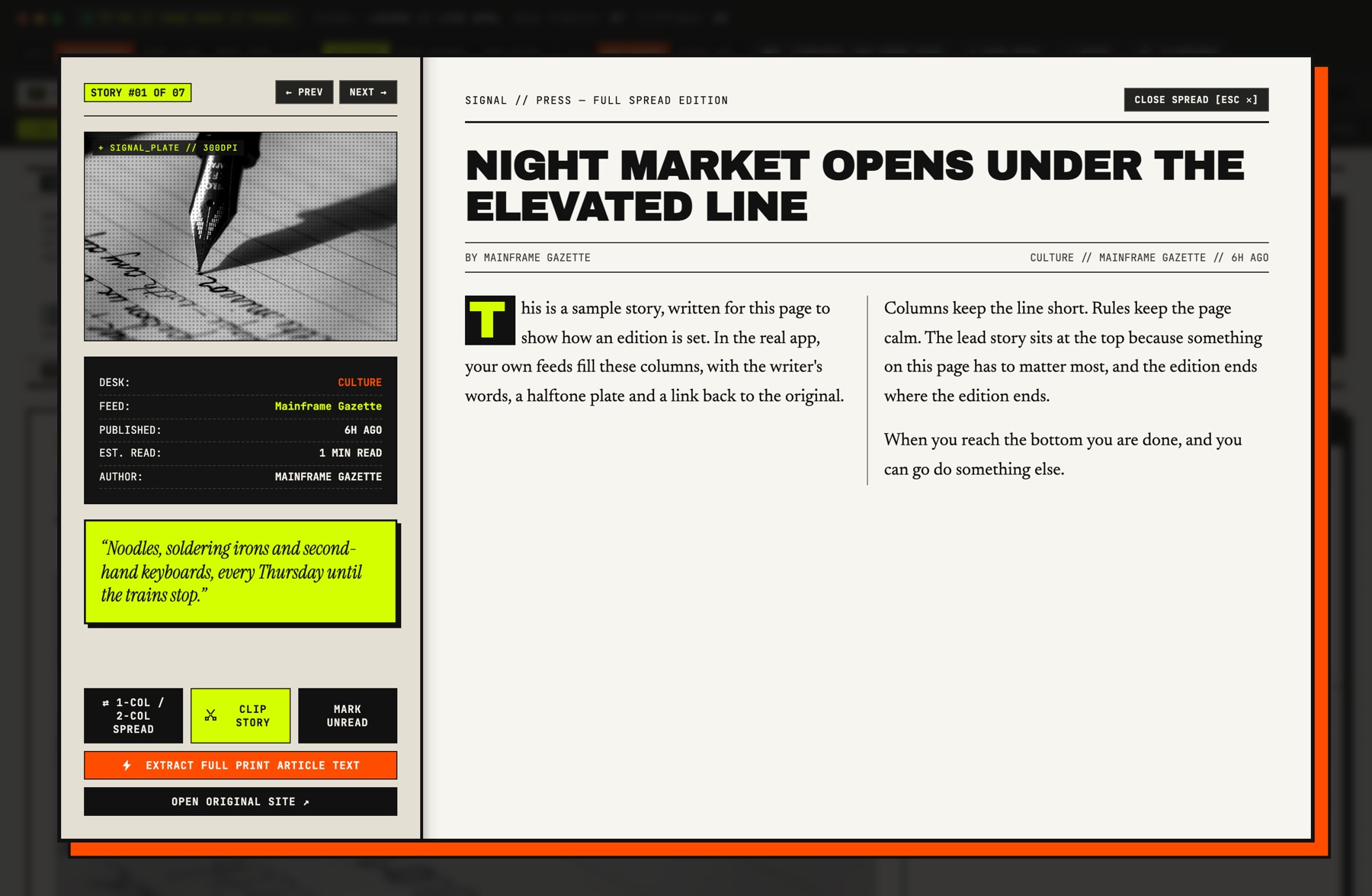
Does the way you take in the news change what you get from it? We read the studies. The evidence is real, the effects are modest, and some of it cuts against us. Here's what we found, fine print included.
Comprehension // 54 studies, 2000–2017
171,055
readers compared across paper and screens
People understood informational text better on paper. The gap was small, grew under time pressure, and got wider over the years studied. It didn't appear for pure narrative.
So Signal Presstakes the clock away. No alerts and no live stream racing ahead of you, because hurried screen reading is where the gap was widest.
Fine print: Effect size g = −0.21, which is small. Delgado et al., 2018.
Recall // Print vs. the same paper online
4.24 vs 3.35
stories remembered after 20 minutes
Print readers of The New York Times recalled more stories than readers of its website. The authors point to lost "salience cues": online, nothing holds still to show what matters.
So Signal Pressgives every edition a lead, priority dispatches and named desks, so your eye knows where to start.
Fine print: A small study of about 45 students. A separate Dutch experiment found no consistent print advantage.
News fatigue // Reuters Institute, 2026
42%
sometimes or often avoid the news
That's up from 29% in 2017. Trust fell to 37%, the lowest since tracking began in 2015.
So Signal Pressstarts from sources you chose, and a Firehose switch mutes noisy folders from the front page.
Fine print: A survey of attitudes. It doesn't show that any reader fixes this.
Interruptions // Field experiment
3× a day
beat a constant drip of alerts
People whose phone alerts arrived in three batches a day felt happier, less stressed and more attentive. Hourly batches barely helped.
So Signal Presssends no alerts. Read it like a paper: morning, lunch, evening.
Fine print: About phone alerts, not news. Removing alerts entirely made people more anxious, so set a time. Fitz et al., 2019.
Compulsive checking // 1,100 US adults
1 in 6
showed severely problematic news habits
Of that group, 73.6% reported mental ill-being, against 8% of everyone else. The authors argue the way people consume news matters.
So Signal Presshas an end. An unread count that reaches zero, and a page that stops.
Fine print: One survey at one point in time. It can't say which causes which.
Correction
None of these studies tested Signal Press. It's a screen, and the print advantage above belongs to paper. We're not promising you'll remember more or feel better. We're making a narrower claim: this reader is built around the conditions the research keeps pointing to, which are chosen sources, a stable page, no interruptions and a real ending.